


We’re in the middle of an AI gold rush. Every boardroom, from the Fortune 500 to agile startups, are echoing with the mandate: “AI everywhere.” Yet despite the excitement, many AI initiatives stall before they ever deliver value.
The problem usually isn’t the technology. It’s the approach. Too many organizations treat AI as an experiment rather than a business initiative, focusing on technical feasibility (Can we build it?) instead of business value (Should we build it? Will it save time, cost, or improve efficiency?).
Based on our experience implementing Generative and Agentic AI for enterprise clients, here is a practical blueprint for running a successful AI PoV.
One note on posture before the blueprint. This is deliberately the cautious road: assist people rather than replace them, prove value in weeks, and scale only once the evidence is in. There is a bolder path too, redesigning whole workflows around AI and betting on transformation, and done well it can return far more. We make that more assertive case elsewhere in our point of view; it simply isn’t this piece. What follows is the lower-risk route, slower to compound but hard to argue with once the numbers land.
Get (as subset of) Your Data Ready First
Before you choose a use case, look hard at the data the AI will depend on: knowledge base articles, catalog items, case histories. In most organizations this, not the model, is the real bottleneck.
The failure modes are mundane but decisive. A knowledge article that’s really a screenshot with no alt text is invisible to AI. A catalog item with an incompatible form configuration can’t be completed by an agent, however capable the model. Content written for a human skimming a page often can’t be parsed by a system that reads it literally.
The fix is unglamorous and high-leverage: baseline your content quality before you start, fix a representative subset, and measure the uplift in what the AI can actually answer. The same knowledge feeds every AI system you deploy, from Now Assist to Copilot to enterprise search, so improving it is one of the few levers you control regardless of which platform wins. Treat data readiness as step zero of the PoV, not a cleanup task for later. You don’t need to fix everything, but you do need your PoV’s input data to be clean.
Sequence Capabilities Strategically
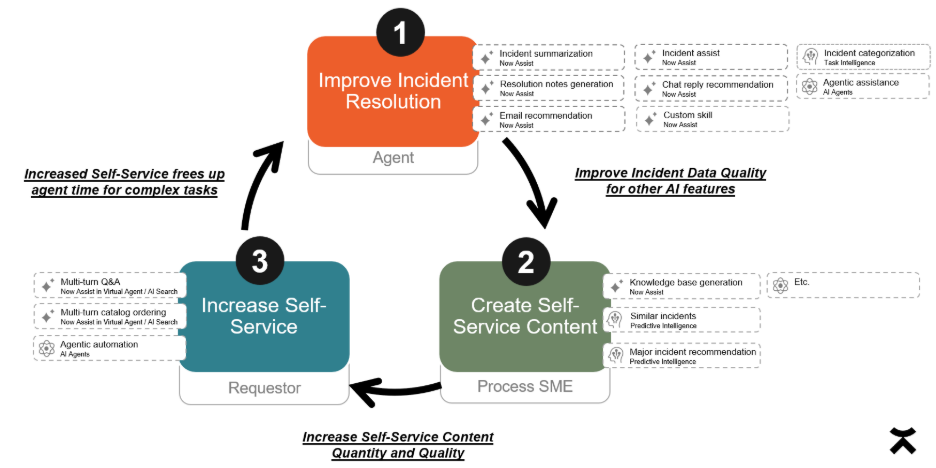
You often hear, “crawl, walk, run.” With AI, you want to go further than this to understand how capabilities build on each other. For example, at Bell Canada, we began with case summarization using Now Assist for CSM. Following that, we introduced resolution notes generation, knowing that the case summaries would help AI generate higher quality resolution notes. We then implemented knowledge base article generation, knowing that the improved resolution notes would assist AI in creating better first drafts of knowledge base articles. The key to AI adoption is to have each phase strengthen the next – delivering compound value rather than isolated wins. That is the patient path; a bolder program would run these phases in parallel and take on more risk to move faster. Here, we favor compounding certainty over speed.
Keep a Human in the Loop
Some of the best PoV candidates are those where AI assists a human expert rather than replacing them. This accelerates deployment by reducing risk and ensuring quality control remains with human experts. Keeping a human in the loop is a deliberately conservative choice. The bolder road hands the model more autonomy behind stronger guardrails; for a first PoV, we prefer to keep an expert in control.
Common use-cases include:
- Summarization: customer cases, IT tickets
- Generation: resolution notes, knowledge articles
- Triage: routing, classification, and prioritization
Starting with simple, out‑of‑the‑box use cases allows you to demonstrate ROI in weeks, not months.
Shift Your Testing Mindset
The most critical differentiator between an experiment and a successful PoV is real user feedback. However, testing AI requires a fundamental mindset shift.
Traditional testing assumes deterministic behaviour: the same input yields the same output. LLMs are probabilistic, not deterministic: meaning that responses vary by design.
It’s not recommended to rely solely on developers to test these systems, as they know how to prompt for the best results. You need real end users (Customer Service Agents, Field Technicians) who will ask vague questions, use slang, and test the system’s boundaries in unexpected ways.
Real users show you where the system breaks. A golden dataset shows you by how much, and whether your last change helped or hurt. This is the discipline that separates a PoV from a demo.
Build a labeled set of real examples: inputs paired with the correct answer or action, drawn from actual cases and validated by the people who do the work today. Score every version of the system against it. That turns “it looked good in three demos” into a number you can defend and re-check on every prompt change, across hundreds of cases rather than the handful you happen to try by hand.
Use three complementary signals, and don’t confuse them:
- Human review: thumbs up or down from real users on live output.
- Automated correctness: an LLM acting as judge, scoring responses against your criteria at scale.
- Golden-response scoring: the system’s output compared against the validated correct answer in your labeled set.
Two things make this pay off. Anchor success to the human process the AI is meant to help, not an abstract standard: if your triage team lead would route a case a certain way, that’s your ground truth. And treat the labeling itself as real work; it’s the AI equivalent of user acceptance testing, and it’s worth resourcing deliberately, with business users on the hook to supply timely ground truth.
From PoV to Production, Deliberately
Here is a fair objection: you don’t put a proof of value into production. It is a good instinct, and worth being precise about. A proof of concept tests whether something is technically possible; a proof of value tests whether it is worth doing, under real conditions; a minimum viable product, or pilot, is the first hardened version real people depend on. Blur these together and you end up running a throwaway prototype as if it were a product. So be clear about which one you are running, and about what “real” has to mean for it to count.
A PoV trapped in a sandbox rarely succeeds. Deploying to a secure and controlled production environment with a curated group of 20–50 users is the fastest path to meaningful results. The point is not to ship the prototype; it is to earn an honest value signal, and only real users and real data can give you one. So run the PoV in a controlled, production-like setting: a curated cohort, live data, the same security and privacy guardrails production would demand, and a fixed time box. Real enough to trust the numbers, bounded enough that nothing breaks if it fails.
The goal is not perfection – it’s iteration. We see the most success when teams release early, listen closely, and evolve fast. Don’t wait for your AI solution to be flawless. Deliver value early and improve over time.
When the value is proven, resist the urge to let the PoV quietly become the product. Graduating to production is a deliberate step, not a rename: harden security and governance, meet the non-functional requirements a real system needs (reliability, monitoring, scale, and a support model), and rebuild what was only scaffolding. Plan and budget for that work from the outset. A “successful pilot” that slides into production unhardened is how a quick win becomes fragile, unsupported infrastructure.
To maximize success, it’s recommended to have:
- A Seamless Integration: Embed AI where users already work (e.g., ServiceNow, web portal). Friction slows adoption.
- A Feedback Loop: Use a simple “Thumbs Up / Thumbs Down” mechanism. Require users to share what they expected when they give a thumbs down. This qualitative data is crucial.
- A Graduation Gate: Agree the success criteria and the go/no-go before you start, so a win triggers a funded path to production and a miss ends cleanly, without lingering in pilot purgatory.
Measure What Matters
A successful PoV is defined by metrics, not vibes. Define your KPIs before you begin:
- Adoption Rate: Are PoV users returning daily?
- Usefulness: What percentage of responses were marked “Thumbs Up”?
- Resolution Time: Did the tool reduce task completion times?
Key Takeaways
Our advice is simple: Start small. Stay simple. Show success.
Build a helpful, secure AI tool that makes your workforce 20% more efficient. That is a value proposition that gets funded, and how you move from an AI PoV to a production-scale rollout.
One last thing. This is the cautious playbook, and we stand behind it, but it is not the only one. A more ambitious, transformation-first approach trades this caution for speed and scale, and for some organizations that is the right bet. If that is the conversation you want, it is one we welcome.
Ready to Fast-Track Your AI Journey?
Moving from a concept to a tangible proof of value requires the right partner. A well-designed PoV is the fastest way to validate impact, reduce delivery risk, and build stakeholder confidence – before you scale.
If you’re ready to move from ideas to outcomes, contact us to schedule a brief working session. We’ll align on your objectives, confirm data and platform readiness, and map a clear plan to launch an AI Proof of Value tailored to your business.