

Nobody within the Salesforce Practice at Ateko touches client work without a Salesforce certification. That’s been the rule since the company was founded.
It’s a good rule. Certifications don’t teach you something, but they serve as a bar, proving you know the platform well enough to be trusted with someone else’s business. But rules like this create a math problem when you’re growing 40% year over year.
We run a 16-week paid learning program in Halifax for people breaking into Salesforce. Career changers, recent grads, people from all walks of life who are curious enough to learn something new. They learn the platform, get certified, and (if things go well) join the team on the other side.
The person who leads our training and education efforts is Glenn, our Sales and Service Cloud Team Lead. Glenn is talented. He is also one person with a day job. And when you’ve got teams across an entire Salesforce practice who all need to keep their certifications current, plus a pipeline of new hires who need to earn theirs, one person can only stretch so far.
So we built something.
Meet Maya
Maya is our AI-powered certification coach. She lives inside a custom web app, and she’s available by text or voice whenever someone on the team needs to study.
Right now, Maya is grounded on three Salesforce exams: Administrator, Platform Foundations, and Agentforce Specialist. You pick your exam and let her know what you want to do. She can teach (break down topics, explain concepts, walk through the makeup of an exam) or quiz (practice questions with scoring, feedback, and the occasional gentle roast when you get one wrong).
She stays in her lane. Ask her about a Microsoft certification and she’ll politely redirect you to the Salesforce options. Ask her to “dumb down” a concept and she will, with examples. Ask for a single practice question instead of forty and she’s happy to oblige.
The voice mode is where it gets fun. Pick a voice, make a call, and Maya talks you through it like a study partner sitting across the table. “Which exam are we crushing today?” is how she opens. She tracks your score, gives feedback, and wraps up with a summary of where you’re strong and where you need work.
From Salesforce Tutor to Moose to Maya
Maya didn’t start with a blank page. She grew out of a series of experiments by our colleague Henrik Nordmark.
While studying for his own Salesforce Administrator exam, Henrik built himself a custom AI study companion called Salesforce Tutor. It was text-based: it explained concepts, answered questions, quizzed him across exam topics, tracked how he was doing, and told him where to focus next. It worked. It accelerated his learning and kept his study time focused on what actually mattered.
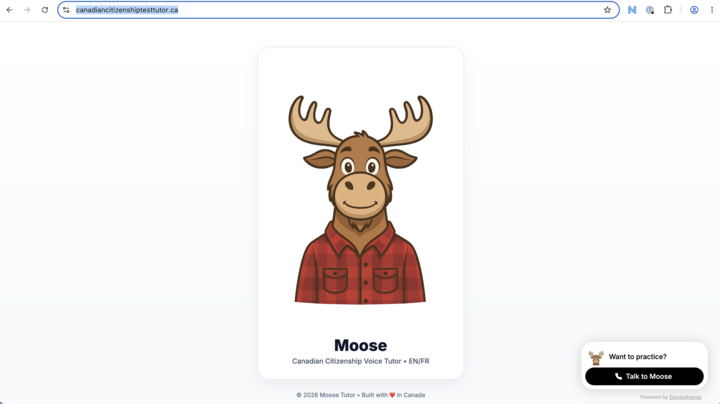
When he later started prepping for the Canadian citizenship test, he carried that same conversational model into a new setting. The official study guide had everything he needed to know, but reading the PDF and listening to the audiobook was, let’s say, not gripping. So he built Moose, a voice-based citizenship tutor with a distinctly Canadian personality.
Moose could ask test-style questions, explain why an answer was right or wrong, dial the difficulty up or down, switch between English and French, and follow a learner’s curiosity into deeper conversations about Canadian history, geography, and government. Where Salesforce Tutor proved the value of an adaptive text-based study partner, Moose moved the experience into voice and gave it a personality you’d remember.
Henrik built Moose for himself, then realized it could help other people preparing for Canadian citizenship too, so he put it online for free. When he demoed it at one of our AI Office Hours sessions, the connection to Ateko’s own certification problem was immediate. Greg Poirier called a Salesforce Administrator tutor a natural extension of the idea, and the room started mapping out how the same approach could cover certification paths across the company.
That seed became Maya. She combines both strands of Henrik’s experiments: the flexible text-based learning of Salesforce Tutor and the natural voice interaction of Moose.
As for Moose, he did his job: Henrik passed the test and is now a Canadian citizen. But Moose is still around for anyone else making that journey, free at canadiancitizenshiptesttutor.ca. If someone in your family, workplace, or community is preparing to become a new Canadian, send Moose their way.
Why This Exists
This wasn’t a client project. Nobody asked us to build it.
As I mentioned on the Digital Nova Scotia podcast last year, one of the things I value about working at Ateko is the ability to innovate. We’re encouraged to experiment with AI, and that freedom sometimes produces great throwaway one-offs and sometimes produces real IP. The Cert Coach started as the former and turned into the latter.
It started from a practical gap: Glenn is great, but he can’t be on call at 11pm on a Tuesday when someone’s cramming for their admin exam. Maya can.
It also fits how we think about AI more broadly. As Greg wrote in The 5% Mandate, we ask every candidate in our interview process how they’re using AI today. Every manager asks every direct report the same question in their weekly one-on-one. We have an internal Slack channel where the team shares AI wins daily, and a weekly AI Office Hours session where people ask questions, demo what they’ve built, and show off what’s working. Building a tool like this for our own people is practicing what we preach.
Let’s Be Honest
Maya is still in beta. Three exams, not thirty. The exam content she’s grounded on is solid, but the experience is still being refined.
We’re sharing it now because waiting for perfection means waiting forever, and the concept works. The initial proof of concept was vibecoded in a matter of hours and refined over about a week. The architecture (RAG for exam content, voice mode, a personality that doesn’t feel like reading a textbook) is proven. Building the system was the easy part. Curating the right exam content and refining the experience is the ongoing work.
The roadmap includes ServiceNow, Microsoft, and Google certifications. If you can study for it, Maya should be able to help you prep.
What This Says About Where We Work
We didn’t build Maya because someone put it on a project plan. We built her because certifications matter to us, learning matters to us, and we’d rather solve our own problems with the tools we recommend to clients than pretend the cobbler’s kids don’t need shoes.
If that sounds like the kind of place where you’d want to work, we’re hiring.