

As Salesforce continues to evolve its marketing ecosystem, many organizations are starting to look beyond feature comparison and ask a broader question: how do you evaluate a move from Marketing Cloud Account Engagement (MCAE) to Marketing Cloud Next?
For many teams, this is not simply about adopting a newer platform. The goal is to determine how differences in architecture, data, automation, and engagement strategy shape future marketing operations.”
Start with the platform model
One of the biggest differences between MCAE and Marketing Cloud Next is the way each platform is structured.
MCAE supports a more traditional B2B marketing automation model, with strong alignment to lead management, email nurturing, and Salesforce CRM processes. Marketing Cloud Next is more closely connected to Data Cloud and a unified customer profile approach.
For organizations considering a move, this difference matters because it affects how audiences are defined, how customer data is activated, and how campaigns are executed across channels.
Consider how data is managed
Data is another major consideration.
In MCAE, marketing activity is typically centered around prospects, leads, and engagement history within a familiar B2B framework. Marketing Cloud Next introduces a broader model, where data from multiple systems can be unified to support more dynamic segmentation and activation.
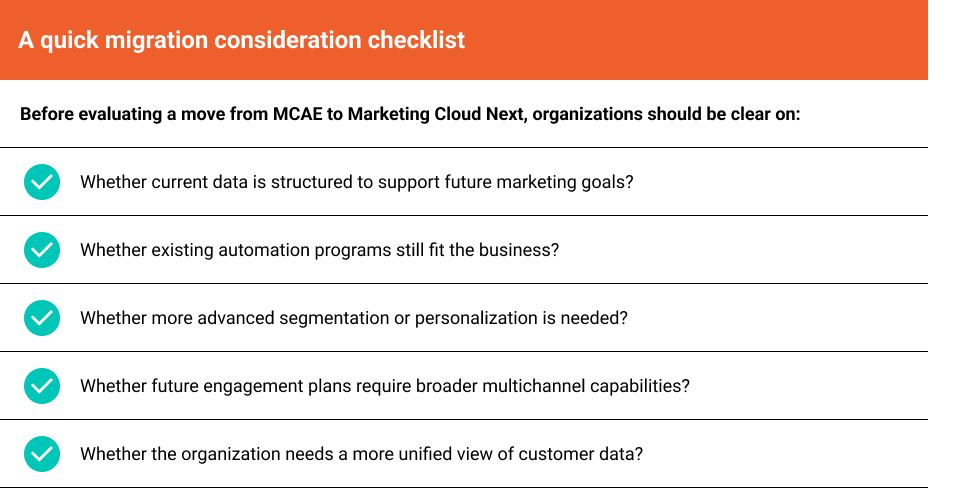
Evaluate whether your current data model supports the experiences you want to create before deciding to move.
Key questions include:
- Is current segmentation mainly lead-based?
- Does the business need a more unified customer view?
- Are there multiple data sources that should drive marketing?
Revisit automation strategy
The two platforms also differ in how automation is approached.
MCAE uses tools such as Engagement Studio, automation rules, and completion actions to support structured lead nurturing and campaign workflows. Marketing Cloud Next expands this approach through flow-based automation and event-driven journeys.
For organizations considering migration, this is a good time to assess whether current automation programs still reflect the way the business wants to engage customers.
Look at AI and personalization needs
AI is another area where the differences between the two platforms become more visible.
MCAE includes important AI-powered capabilities such as lead scoring and engagement insights. Marketing Cloud Next extends this further through deeper integration with Einstein AI and tools that support segmentation, content generation, and broader data-driven engagement.
If an organization is looking for more advanced personalization or more flexible use of customer data, include that in the migration conversation.
Think about channel and engagement complexity
Another consideration is the type of engagement model the business is moving toward.
MCAE remains a strong fit for many B2B marketing teams, especially those focused on lead generation and sales alignment. Marketing Cloud Next is the right choice when organizations are looking for broader multichannel engagement and more connected customer journeys.
That does not mean migration is necessary for every team. But it does mean organizations should assess whether future marketing needs still align with the platform they use today.
Final thoughts
Migration from MCAE to Marketing Cloud Next should not be viewed only as a technology decision.
It is also a decision about marketing model, data strategy, automation design, and long-term customer engagement goals.
For some organizations, MCAE will continue to be the right fit. For others, the capabilities introduced in Marketing Cloud Next represent a shift worth exploring more closely.
Want to discuss your marketing automation strategy or explore whether Marketing Cloud Account Engagement or Marketing Cloud Next is the right fit for your organization?
Connect with our team. We’ll help you get the most out of your marketing technology.