

By Greg Poirier, SVP of Ateko
Over two decades, I have seen the enterprise landscape shift every time a new transformational tool hits the desk of an employee. I was there when laptops became the standard, when we all moved from on-prem to cloud and when smartphones were widely deployed to Sales and Field teams. In all three cases, the c-suite strategic plans for how those tools would be used were entirely wrong. Also though, in all three cases, employees still became exponentially more efficient. Remarkably more efficient than anyone expected, we were just collectively really wrong on how they would do it.
Today, we are at the same moment with AI. Across the land, organizations are busy drafting multi-year strategies for pointed applications of AI solutions. Within the Ateko Salesforce Practice, we have taken a different route. We are not waiting for purpose built tools or to get consensus on a 36 month plan. We have a simple, single AI mission: We will be 5% more efficient across our practice, every single quarter, for the next 4 years
The Math of Compounding Efficiency
In professional services, essentially the best human brains for hire, work cannot (and should not) be completely eliminated by AI. However, the “tax” of the least rewarding labor can be significantly reduced.
We have committed to a worldview where we reduce “units of effort” in both delivery and back office by 5% every quarter. Unfortunately, because this math involves a compounding reduction instead of compounding growth, it doesn’t quite add up to 20% by the end of the year; it is a time savings of roughly 19% in year 1, but still only gets to ~50% in year four .
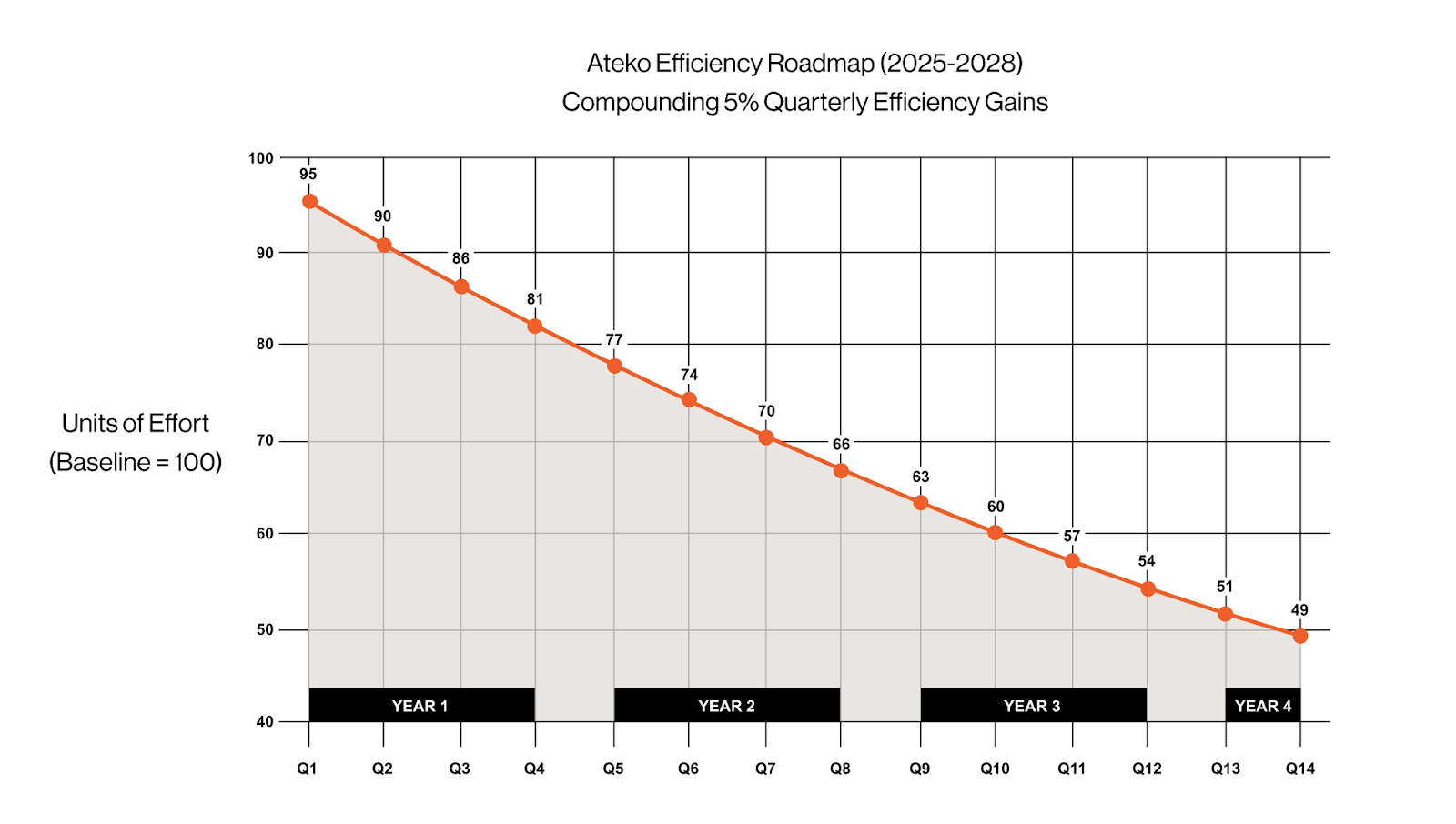
Our goal is simple: By the end of this year, our practice will deliver the same high-end outcomes and white glove service with roughly 20% of the effort we did in 2025. We are not doing this with one tool, but by embedding multiple approved enterprise AI tools like Gemini into the daily workflows of every practice member.
Culture at the Front Door: The “Clean Sheet” Advantage
Improvements do not happen because you tell people to move faster. In our world it happens because you hire for curiosity.
Historically, the Ateko Salesforce Practice’s headcount has grown by roughly 40% each year. This gives us a change-management headstart most organizations do not have: 40% of our workforce each year shows up “clean,” with no bias of how work “should” be done. We tell them from Day 1, “This is how we do things here,” and even if we only started doing that thing the day before, they accept it as the baseline expectation.
This all begins in our interview process. We have always screened for curiosity, but beginning in 2025, we also began to ask every candidate, regardless of seniority: variations of “How did you use AI today?”. We know that if candidates are not already using AI to solve problems at home, school/where they work today, they will not thrive here.
Socialization and Reinforcement: The Management Rhythm
We work hard to ensure that AI usage is not seen as a “nice to have”, rather it is a core expectation for every delivery and backoffice team member. For this to work, it needs to be demonstrated and reinforced at the Leadership team level. As such, every manager asks each of their direct reports in their weekly 1:1, “How did you use AI this week and what did you learn?”. Our expectation is that they are experimenting and we reward that, but also that sometimes things won’t work – hence the interest in “what did you learn”.
Similarly this is being socialized in the fabric of where team members do work. AI is naturally available and embedded in their email, spreadsheets, slides, development processes etc. Also though the “Everyday AI” Slack channel is providing a beating drum of examples of how team members are using AI and we make an effort to demonstrate the Leadership team’s usage in our All Hands call.
Automating the Muck, Protecting the Joy
We focus AI efforts on what our team likes doing least: the “muck”. Afterall, if you want someone to adopt a tool – showing them how it gets rid of the stuff they hate to do is a pretty good hook.
Every quarter, we survey our team, and the results are consistent. When asked what they push to the bottom of the pile and dislike, it is documentation, QA, meetings and creation of training materials. Perhaps more importantly, clients know that documentation, QA and training materials are important, but they also hate to pay for it.
AI happens to be spectacularly good at these types of tasks. We can use it to take some of these burdens (joy killers) off the team’s plate, reduce the project cost to clients for them and free brilliant minds to do more of what they love.
As an added bonus – when applied to the right kinds of tasks, it produces a superior, not inferior product. Quality Assurance is a great example – yes you need a human in the loop, but an AI QA Agent is as focused the 5th time it checks a piece of code being moved through environments as it was the first, even if it has been staring at it for three hours. That’s a painful process for almost any human, but also something only a rare few enjoy.
I’m a Long Run AI Optimist
We have a great luxury here, in that we historically have always needed to hire faster than we were able to. Our growth has been constrained by the amount of talent in the ecosystem, not demand for our services. AI is a boon in that sense, we can continue to grow, but be able to expand at the rate our current and future clients would like. Every Consultancy and Service Implementor struggles with periods where they need to start a project later than is ideal, because the staff complement isn’t available or crunch periods where peak workloads occur, that can’t be staffed for in a fiscally responsible way on an annualized basis.
If we look at history, there is the oft cited Accountant Paradox. In the 80’s as adoption of the spreadsheet began to take off, there was a fear that it would kill the Accounting industry. Instead, it elevated it as a service – taking roles that were historically manual entry into ledgers and adding value. Taking something like complex financial modelling from a luxury into a widely available commodity. It made Accountants more valuable, not less.
I believe AI is going to have a similar impact on the Salesforce Service Implementor ecosystem. It has the potential to bring the day-to-day servicing costs of maintaining a Salesforce ecosystem closer to zero, freeing up a massive amount of budget for complex, transformational, high value projects that were previously unaffordable. Not only can some of the budget formally allocated to maintenance be shifted, but AI efficiency will also mean the raw cost of each project will be less.
I like to think that history is reminding us that when the cost of an input (in our case, what we call “units of work”) plummets, the scale of the economy around it substantially increases.